
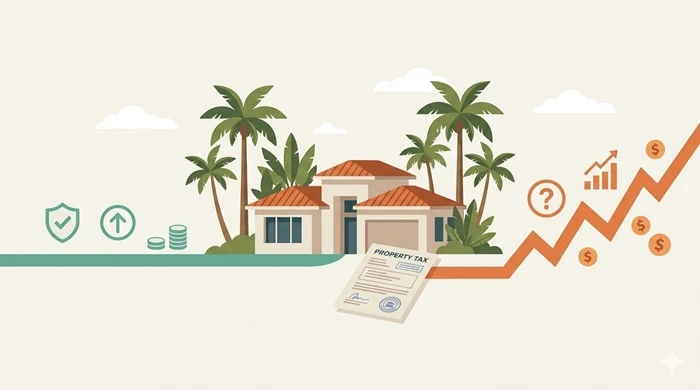
Buying a home in Broward County can bring an unexpected surprise when the next tax bill arrives. A buyer may compare it with the seller’s old bill and ask, “why would property taxes double?” A careful review of Broward County property taxes can then reveal the reason. In many cases, the tax rate did not double. Instead, the property may have been reassessed after the ownership change, while the seller’s long-standing exemptions and assessment protections no longer apply in the same way.
Key Takeaway
-
A sale can reset the assessed value toward current market value.
-
A previous owner’s Homestead Exemption does not automatically become the buyer’s exemption.
-
Save Our Homes limits qualifying assessed-value increases, not the total tax bill.
-
Millage rates, exemptions, and taxable value all affect the final amount.
Why Do Broward County Property Taxes Increase After a Sale?
The biggest reason Broward County property taxes can rise sharply is the difference between a long-time owner’s protected assessment and a new owner’s post-sale assessment. The Broward County Property Appraiser specifically tells buyers not to assume the seller’s tax bill will remain the same because a change in ownership can reset assessed value to full market value.
That is why Broward County property taxes can change so much even when the home itself has not changed. Estimating Broward County property taxes before closing is therefore essential.
How Florida Taxes Are Calculated
Florida property tax calculations involve three important figures: just value, assessed value, and taxable value. Just value generally represents market value for tax purposes. Assessed value reflects applicable assessment rules, while taxable value is the assessed value after exemptions.
The Florida Department of Revenue explains that the tax liability is calculated using taxable value and the applicable millage rate. Several taxing authorities can contribute to the final amount, including county, municipal, school, and special districts.
So, what are property taxes in practical terms? They are recurring taxes on real property that help fund local government and public services.
Why Can a Tax Bill Double After Buying?
So, can a property tax bill double? A large increase can happen when a previous owner had a much lower protected assessment and the sale results in a new assessment closer to current just value.
For example, a homeowner may have purchased decades ago at a much lower price. Florida’s Save Our Homes rules can limit annual increases in the assessed value of a qualifying homestead. A buyer purchasing that same home at today’s market value does not simply inherit the seller’s protected assessment.
The result can be a dramatic difference in Broward County property taxes from one owner to the next.
This is important when evaluating South Florida housing, where current purchase prices can differ considerably from historical property values.
The Homestead Exemption Matters
A qualifying primary residence may receive Florida’s Homestead Exemption, which reduces taxable value and provides access to Save Our Homes. The Florida Department of Revenue says the exemption can reduce taxable value by as much as $50,000.
Broward County explains that permanent-residence status is important and uses January 1 as the key date for determining eligibility for a tax year.
Understanding the exemption can make Broward County property taxes easier to estimate and budget. It also helps explain Broward County property taxes shown after closing.
How Save Our Homes Affects the Assessment
Save Our Homes limits annual increases in the assessed value of qualifying homesteaded property to the lower of 3% or the applicable CPI change. For 2026, the Florida Department of Revenue lists a 2.7% cap.
Broward County property taxes should therefore be projected from the buyer’s expected assessment instead of copied from the seller’s historical bill.
Millage Rates Can Change the Final Amount
Property value is not the only factor behind the bill. Broward County property taxes also reflect millage rates adopted by multiple taxing authorities.
County government, municipalities, school districts, and special districts can each contribute to the total. Their combined effect can materially change Broward County property taxes. Some bills can also include non-ad valorem charges for specific local services. Florida’s Department of Revenue notes that multiple taxing authorities can produce a combined tax obligation.
What Buyers Should Check Before Closing
A tax review should be part of the home-buying process. Check the property’s just value, assessed value, taxable value, exemptions, and recent tax history.
Then estimate the likely post-sale assessment instead of simply using the seller’s current bill. Broward County provides buyer resources and a tax estimator because the existing bill may reflect the previous owner’s assessment and exemptions.
Buying Home Without Agent: What Tax Information Matters?
Buying home without agent does not change Florida’s property tax rules. Reassessment, exemptions, taxable value, and millage rates work the same way regardless of how the transaction is handled.
Property Tax Planning in South Florida
South Florida real estate often includes properties with very different ownership histories. One homeowner may have accumulated years of assessment protection, while a new buyer starts with a different assessment after the sale.
That makes the historical tax bill useful for context, but not necessarily reliable as a forecast. A better estimate considers current value, expected assessment, exemptions, and local rates.
Supreme Royalty Investment provides real estate services in South Florida, supporting property owners with guidance around transactions and selling options. Homeowners exploring a sale can learn more about sell your house fast and evaluate available options.
Other Tax Issues Homeowners Should Know
Homeowners dealing with delinquent property taxes in Florida should understand how unpaid taxes may affect a sale.
It is also useful to understand Florida Homestead exemption works when calculating ownership expenses.
Before selling, homeowners can review what taxes you pay when selling a house in Florida because sale-related and annual property taxes are separate.
For homeowners considering alternatives to a traditional sale, cash home buyers can provide additional background.
How to Read the Broward County TRIM Notice
Florida’s Truth in Millage, or TRIM, process gives property owners information about proposed taxes, assessed values, exemptions, and millage rates.
Broward County states that its TRIM notice reflects the property’s assessment as of January 1.
Review each section to identify the source of the change.
What to Do When the Increase Looks Wrong
Check ownership, just value, assessed value, exemptions, and the assessment date.
Florida’s TRIM process gives taxpayers an opportunity to review proposed taxes and participate in the process.
Assessment and exemption questions generally belong with the Broward County Property Appraiser; billing questions go to the Tax Collector.
Can Property Taxes Increase Every Year?
Yes. Even when assessment protections apply, the total bill can change because taxable value, exemptions, millage rates, and other applicable charges can change.
Save Our Homes limits qualifying assessed-value increases under its statutory formula, but it does not freeze the total tax bill. This distinction is important when forecasting Broward County property taxes. Buyers should build that estimate before finalizing a budget.
Conclusion
A sharp increase in Broward County property taxes after buying a home is usually connected to Florida’s assessment rules rather than a simple doubling of the tax rate. The seller may have benefited from years of Homestead and Save Our Homes protections, while the buyer receives a new assessment after the ownership change.
The clearer way to understand Broward County property taxes is to compare just value, assessed value, taxable value, exemptions, and applicable millage rates. That review gives buyers a more realistic picture of future costs and explains why the same property can produce very different tax bills for different owners.
Frequently Asked Questions
1. Why did my property taxes increase after buying a home in Broward County?
A change in ownership can reset assessed value, while the previous owner’s exemptions and assessment protections may not carry over.
2. Does the seller’s Homestead Exemption transfer automatically?
No, the new owner must meet the eligibility requirements and file for the exemption.
3. Does Save Our Homes prevent the tax bill from increasing?
No, it limits qualifying assessed-value increases, while the total bill also depends on rates and exemptions.
4. Where can I check my property assessment?
The Broward County Property Appraiser provides property records, assessment information, exemptions, and buyer tax resources.
5. Can a property assessment be challenged?
Yes, Florida provides a TRIM review and value-adjustment process for taxpayers who believe an assessment is incorrect.